The Arcade Cabinet as a Public Invitation
An arcade cabinet makes play visible before anyone inserts a coin. Its controls, screen and position in the room invite strangers to watch, join in or take a turn.
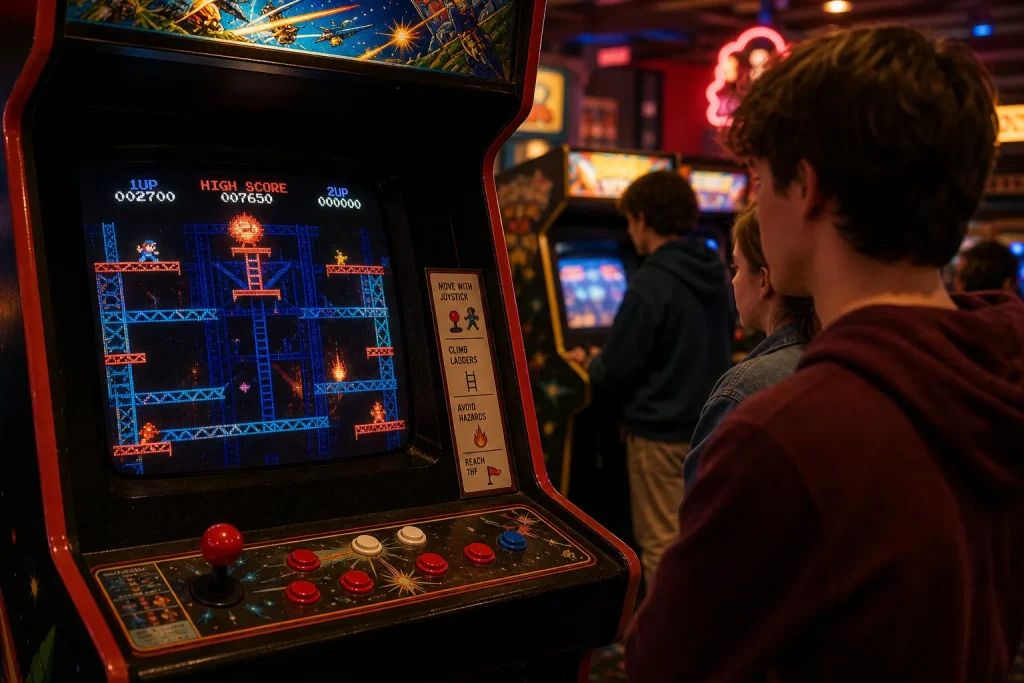
The common mistake is to treat an arcade cabinet as a screen with buttons attached. That overlooks what its layout asks a visitor to do: watch a round, learn a control, or take a turn without interrupting someone. If those cues are unclear, a passer-by may leave rather than risk getting in the way.
The cabinet sets the terms of an encounter
A cabinet has a recognisable front: the control panel marks where the player stands, while the raised screen lets other people see the action. Its shape makes play public without requiring anyone to join. That matters in an arcade, where a visitor might be curious but uncertain whether it is all right to stop and watch.
The cabinet’s position can make that uncertainty better or worse. A machine facing a doorway may leave spectators in the route; one tucked behind another cabinet can be hard to notice. For staff arranging a floor, the useful question is not how much space a machine occupies but whether a person can watch without blocking someone else.
Controls teach through their shape
A joystick beside a cluster of buttons suggests one kind of interaction. A trackball, spinner or pair of large buttons suggests another. These controls communicate before a player reads a rule, but worn labels or an unusual layout can leave a newcomer guessing.
Keep instructions short and concrete. “Move with the joystick” or “Turn the spinner to move the paddle” connects a control to an action. A watcher can then compare the player’s hands with the screen and see what changes. If the game has a second player position, make its controls easy to identify; otherwise, a newcomer may mistake an available place for a service panel or decoration.
The game needs to make its action legible
A spectator rarely sees every detail from behind a player. Large, distinct objects and a clear focal point help someone understand what is happening without studying a small status display. A visible change after a successful action can make the point of a moment clear, even when room noise swallows the sound.
That does not mean every screen needs constant movement. When many elements compete for attention, a watcher can lose track of the player’s goal. A clear objective, readable hazards and an unmistakable result give an audience a simple thread to follow.
Say an arcade manager notices that visitors stop at a maze game but walk away before a round ends. Imagine the manager checks whether the goal is visible, whether the player’s character is easy to distinguish from hazards, and whether success changes the screen clearly. If the goal is buried in a small status area, the manager could add a brief instruction beside the controls; if the goal is clear but the character blends into the maze, the manager could ask the operator about a display adjustment. The observable result to look for is whether a watcher can explain what the player is trying to do and recognise when the round changes, without needing the player to narrate it.
A simple cabinet check points to useful changes
Before moving a machine or rewriting its instructions, check the specific point where visitors seem to hesitate. For each item, note the observation and choose the matching action rather than changing several things at once.
- Check whether the cabinet can be seen from the usual approach; if another machine hides its screen, then consider moving the cabinet or changing its orientation, and if it is already visible, leave its position alone.
- Check whether a spectator can stop without standing in a doorway or blocking play; if the route is obstructed, then choose a less congested position, and if the route stays clear, do not move the machine for this reason.
- Check whether the controls are clean and their labels readable; if labels are worn or obscured, then clean the panel or replace the instruction card, and if each control is easy to identify, keep the current labels.
- Check whether a newcomer can connect a control to an on-screen action; if the connection is unclear, then add a short action cue, and if it is apparent, avoid adding extra text.
- Check whether the game’s objective is visible to someone standing behind the player; if it is hidden in small symbols, then make the objective clearer with a concise instruction, and if it is already apparent, leave the screen explanation unchanged.
- Check whether a successful action or round ending is easy to recognise; if the change is ambiguous, then ask the operator whether an instruction or permitted display setting can clarify it, and if the ending reads clearly, focus on another source of hesitation.
- Check whether a second player’s position is genuinely available and easy to understand; if it is available but unclear, then label the controls plainly, and if the game is designed for one player, do not imply that a second position is open.
Make the handover feel clear rather than forced
Watching a round can be a complete part of an arcade visit. A person may enjoy following a close escape without wanting to play. But when they do want a turn, an unclear ending can make it awkward to approach the controls or ask the current player to move.
A distinct end screen or a clear return to the start gives the player and nearby visitors a shared cue. If the cabinet offers another player position, its layout can make that option visible. If turns are solo, a brief invitation from the player or a simple instruction about starting again can help without suggesting that every spectator must join.
Fit the cabinet to its neighbours
Other machines affect what people can see and hear, and the route between them determines whether anyone can pause nearby. A loud, visually busy game may suit a lively part of the room; a quieter cabinet may be easier to watch in a less congested spot. The best placement depends on the experience the game offers and how people move around it.
When someone hesitates, look for the particular obstacle. Do they fail to notice the cabinet, search for the controls, or miss the moment a round ends? Each observation points to a different response: adjust placement, clarify an instruction, or make the handover easier to recognise. A cabinet becomes a public invitation not by demanding an audience, but by making watching comfortable and the next action understandable.