The Local High-Score Table and Its Unwritten Rules
A local score table can preserve a group’s memory of play without becoming a measure of who belongs. Explore rivalry, recognition and record-keeping as distinct ways to shape the display.
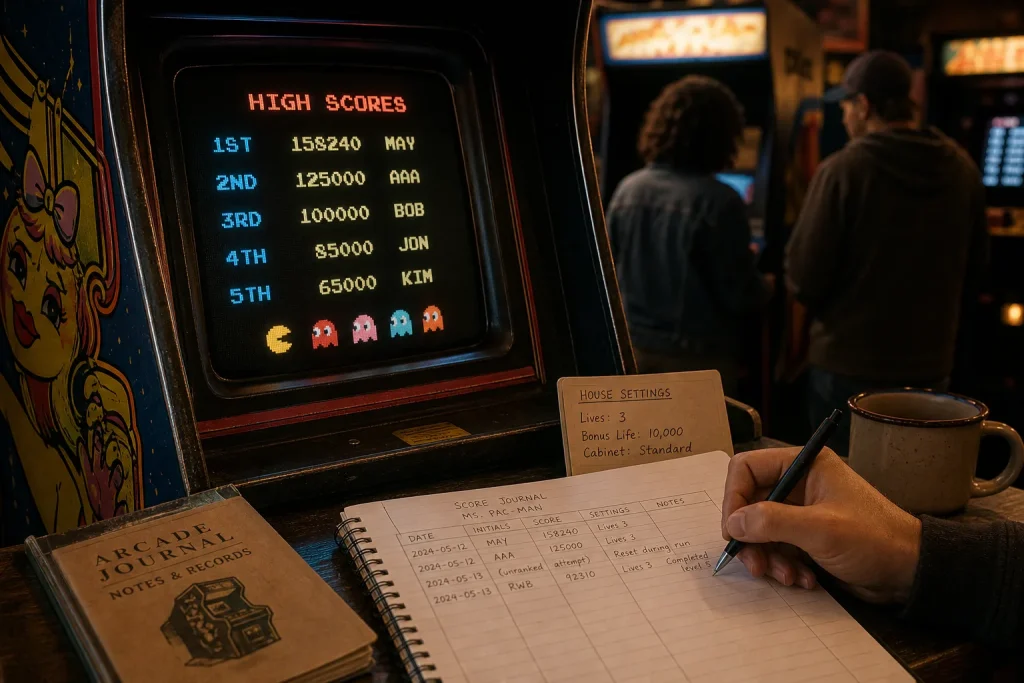
The most common mistake with a local high-score table is treating it as a miniature version of the arcade: a place for rivalry, turn-taking and welcoming newcomers. That can make it repeat the room’s social rules instead of focusing on what a score table does best: preserve a record of play. Without a clear purpose, its entries become hard to interpret, and a name on the screen says little about how or when the score was earned.
A score table can be a local archive, a set of personal milestones or a record for comparing runs. These customs can coexist, but it helps to decide what each entry is meant to preserve. The answer shapes what you record, how you interpret old initials and what happens when the cabinet resets.
A score table preserves traces of play
On many classic games, the screen gives a player room for only a few initials. That small space turns the table into a compressed record: it shows a score and a name, but leaves out the player’s method, the date and the circumstances. A familiar set of letters might recall a memorable run to regulars, while a stranger sees only a ranking.
That gap is part of the table’s character. It is not a complete archive, and it need not become one. Instead, a group can treat it as a prompt for memory: who played, which run became a story, or what a particular score meant to someone at the time. If the table’s limits are understood, there is less temptation to read more into an entry than it can tell you.
Say a small games club has a Galaga cabinet with room for a few initials. A member reaches a score they are proud of, enters “MAY”, and tells the group it was their first run past a difficult section. The club keeps the screen entry as it is and, with the player’s permission, adds a brief note to its paper game journal. The observable result is a compact public display and a separate record that preserves the story without crowding the screen.
Recognition works best when players control their names
For some groups, the table matters because it brings a familiar name back into view. A returning player may recognise a nickname, or a friend may remember the run behind it. The entry can mark participation even when the score is not near the top.
Recognition can also become a private code. Initials may be meaningful to regulars but opaque to everyone else, and a player may not want a real name displayed or copied into a notebook. Offer a choice of initials, nickname or no entry. Ask before adding screen names to a separate record, and make it easy to decline without explanation.
A group can make room for different kinds of achievement without changing the game’s ranking. It might keep a note of a first completed level or a player’s chosen personal milestone. These details belong in an optional journal or club notice, not as a claim that one kind of play matters more than another.
Simple records make old scores easier to interpret
A score alone rarely explains its own context. The cabinet might have been restarted, its settings might have changed, or a fault might have interrupted a run. If a group compares results over time, a modest record can distinguish an ordinary entry from one that needs a note.
Use materials that suit the group. A paper notebook near the cabinet can record the date, game settings and any reset that affects the display. A club spreadsheet or private Discord channel can hold the same details when people need to refer to them later. Keep personal information out unless the player has agreed to its inclusion.
- Check whether the displayed score belongs to the current session; if the cabinet has been reset, note that the earlier display is gone and use the paper log or club record if one exists.
- Check whether the game settings match the group’s agreed configuration; if they do, mark the entry as comparable, and if they do not, keep it separate or label the difference.
- Check whether a known cabinet fault interrupted the run; if it did, record the score as an interrupted or unranked attempt, and if there was no known fault, leave the ordinary entry unchanged.
- Check whether the player wants their initials or nickname copied into another record; if they agree, add only the chosen name, and if they decline, leave the external record anonymous.
- Check whether the table has room for the new entry; if it does, let the game display it, and if it does not, preserve any relevant note in the journal rather than altering another player’s name.
- Check whether the entry can be interpreted from the screen alone; if it cannot, add a brief dated note to the group record, and if it can, avoid adding unnecessary detail.
Imagine a club using an invented rule that records the game settings and marks any run interrupted by a visible cabinet fault as unranked. One evening, a player enters a score on Ms. Pac-Man before the display clears during a reset. The organiser checks the settings card, confirms the reset happened, asks whether the player wants their initials in the club log, and records the run as an unranked attempt when the player agrees. The screen remains clear for the next entry, while the journal explains why this score was not treated as comparable.
Choose a purpose before adding more rules
A casual group may need no separate log at all. If players mainly enjoy recognising a handful of familiar scores, the screen and a shared understanding may be enough. A club that compares runs across different gatherings has more reason to note settings and resets. The useful rule is the one that answers a question the group actually faces.
When the table becomes confusing, ask what information is missing. If people cannot tell whether a score is current, note resets. If they do not know whose initials are shown, invite players to choose a nickname or keep an optional key with permission. If the group is unsure how a run was treated, record the relevant decision without turning the journal into a verdict on the player.
Leave room for entries that carry personal meaning, and for players who prefer not to explain theirs. The screen can remain a brief record; a notebook can hold context when someone wants it preserved. Separating those roles keeps the display readable and lets the group remember more than a rank without asking every player to share the same story.