The Checkpoint That Changes a Level’s Rhythm
A checkpoint does more than save progress: its position determines how often players can practise a hard section, and how much of the level they must replay to reach it.
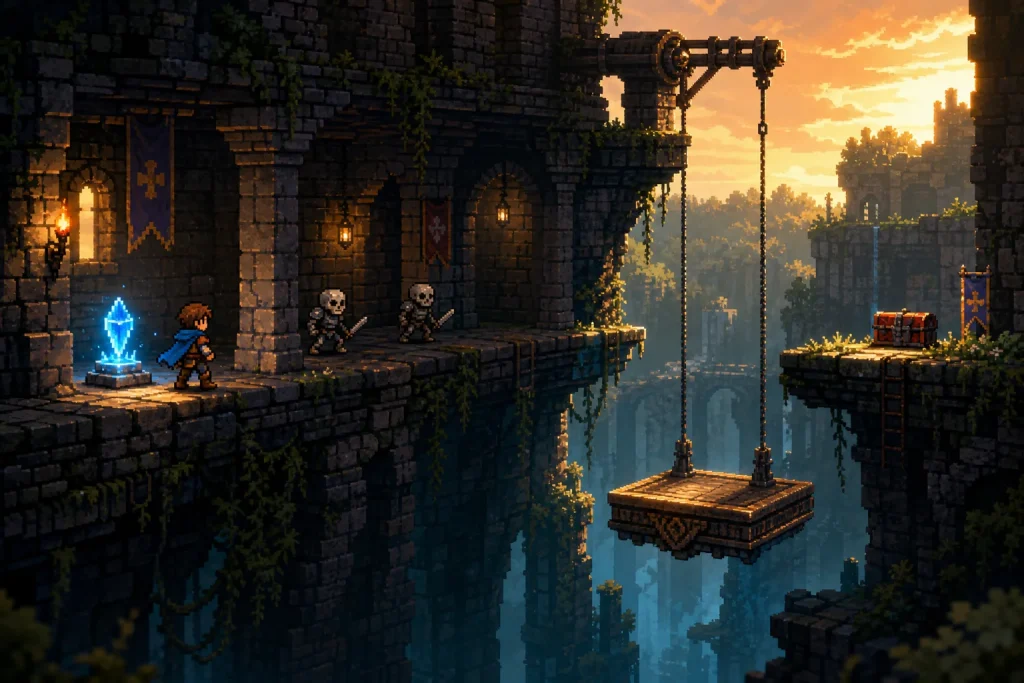
The common mistake is to place a checkpoint wherever a level happens to have a spare patch of floor. Put it too far from a difficult jump, and every failure charges the player another stretch of repetition before they can try again. Put it right on the obstacle, and the challenge may lose its build-up. In classic games, where a few screens could make up an entire stage, that small placement decision shaped the level’s rhythm.
Count what the player repeats
A player who misses a jump is not only failing that jump. They are also being asked to replay everything between the checkpoint and the miss. That replay can create useful tension: a short warm-up may bring the player back into the level’s timing and movement. But a long, routine stretch can turn practice into a toll.
When placing a checkpoint, look backwards from the obstacle. Which sections ask the player to make fresh decisions, and which merely repeat actions they already understand? A short sequence of familiar platforms may keep the approach lively. A long corridor of enemies the player has already learned to pass can make each retry feel like waiting for permission to practise.
- Check how many distinct decisions lie between the checkpoint and the obstacle; if most of the route asks for new choices, keep it as a warm-up, but if it repeats solved actions, move the checkpoint closer or shorten the return route.
- Check whether the player can see the obstacle from the respawn point; if its timing or shape is readable there, keep the view, but if scenery hides the useful cue, shift the marker or open the sightline.
- Check the landing space after respawn; if it is safe enough to orient and choose an approach, keep it, but if a hazard immediately pressures the player, add a safe ledge or move the marker back.
- Check whether the approach teaches a skill needed for the obstacle; if it provides useful practice, retain a compact version, but if it only repeats familiar movement, remove it from the retry route.
- Check what changes on a second attempt; if the player can apply new timing, positioning or route knowledge, keep the retry focused, but if the long approach prevents that adjustment, shorten it or offer a meaningful route choice.
- Check what follows the difficult section; if a calm landing makes progress clear, preserve that space, but if another hazard obscures the transition, add a safe pause or place a checkpoint after the sequence.
Say you are designing a platform stage with a tricky moving lift. For this invented scenario, suppose the lift is preceded by a hallway of familiar enemies and followed by a safe ledge. First, place a temporary checkpoint at the hallway entrance and note the route the player must repeat after a fall. Next, move the marker to a clear platform beside the lift, where the player can watch its motion before jumping. Then check whether the respawn leaves room to orient and whether the safe ledge still marks the end of the sequence. The resulting decision is to keep the nearer marker if the hallway offers no useful practice; if it teaches a movement skill needed for the lift, retain a short version before the checkpoint. Either way, retries now focus on the lift rather than replaying a solved passage.
Leave room for a useful breath
A checkpoint immediately before a demanding sequence can be generous without feeling arbitrary. The space after it still matters. A safe ledge, a brief stretch of flat ground or a clear view of the obstacle gives the player a moment to regain control and understand what comes next.
This pause need not be empty. A visible hazard can introduce the timing rule, or a harmless version of a jump can let the player feel the required distance. In older platformers, a change in scenery or a distinct screen boundary could perform some of this work. The aim is to make the checkpoint feel like a deliberate threshold, not a marker buried inside a difficult action.
Consider how the player arrives. If they respawn facing a wall, they may need to turn around before they can read the room. If a hazard is already moving towards them, the first attempt begins under pressure. A small safe landing area lets the player orient themselves, then choose when to engage.
Use distance to tune the cost of failure
Checkpoint spacing is one way to decide how costly a mistake feels. Close spacing supports experimentation: players can try a risky route or test a timing window with little lost progress. Wider spacing makes each attempt more consequential. That can suit a climactic section, provided the level has prepared players for the stakes.
The important distinction is between a setback that sharpens attention and one that drains it. Replaying a compact, varied approach can keep the player alert. Repeating a long sequence that offers no new decision asks for patience without teaching much. If a difficult passage is intended to test execution rather than endurance, place the checkpoint so the retry practises execution.
For a more demanding stage, a checkpoint can sit before a short chain of hazards rather than before every individual jump. The player then has to hold several decisions together, while still avoiding a full replay of the level. This preserves a sense of commitment without making one early mistake erase a long stretch of progress.
Let the checkpoint teach the level’s structure
Players often read a checkpoint as a quiet piece of design language: what comes next is important enough to mark. A checkpoint before a new enemy, a rising hazard or a shift in movement can tell the player to pay attention. Its position can also signal that the previous section has established a skill the next one will combine with something new.
That signal works best when the checkpoint agrees with the level’s learning curve. If a new mechanic appears and the player must pass several unrelated obstacles before reaching a save point, they may have to relearn it after every failure. A checkpoint near the first demanding use of the mechanic gives room to explore its rules, then lets the next section build on that understanding.
Think about what the player knows at the moment they respawn. If the challenge depends on recognising a safe gap between hazards, keep the relevant visual cue in view. If success depends on a rhythm, make sure the player has enough space to watch that rhythm before committing. The checkpoint can return the player to a useful lesson, rather than merely to a coordinate.
Make retries respond to what the player has learnt
The first time through a section, players are discovering its layout. On a retry, they already know where the danger is. A good checkpoint respects that change. It returns them close enough to practise the hard part, while leaving room to adjust their plan instead of forcing them through a lengthy, unchanged prelude.
Some classic games made repeated approaches more interesting by varying the route or adding a small obstacle before the main challenge. That can work, but variation should not obscure the skill being practised. A new enemy on every retry may create fresh decisions; it may also distract from a jump whose timing is the actual point. Keep the route back informative, not busy for its own sake.
Ask what the player can change on the next attempt. If the answer is their timing, position or choice of route, a nearby checkpoint helps them act on that knowledge. If the answer is nothing because the approach is fixed and lengthy, the checkpoint is probably too distant or the return path needs more meaningful choices.
Make safe ground mark a change in the level
A checkpoint’s position after a difficult section matters as much as its position before one. If the player clears a demanding sequence and lands directly in another hazard, they may not realise that they have reached a new phase. A calm landing or clearly marked space lets the success register before the next demand begins.
That breathing room is especially helpful when a level changes its rules. A player who has just learnt to cross moving platforms may need a moment before facing an enemy that interrupts their timing. A checkpoint after the platform sequence preserves the achievement and makes the new problem legible. A checkpoint before it, by contrast, keeps the sequence as the central test.
As you place markers, consider what a respawn should invite. Should the player immediately try the same manoeuvre again? Should they reconsider the route? Or should they arrive at a safe point and take stock before entering a new section? The answer determines not just where the checkpoint goes, but what kind of persistence the level rewards.
One final detail is easy to miss: make the checkpoint’s state unmistakable. A distinct animation, sound or change in its appearance can tell the player that progress has been recorded, so they know what a failure will cost before they choose to press on.